
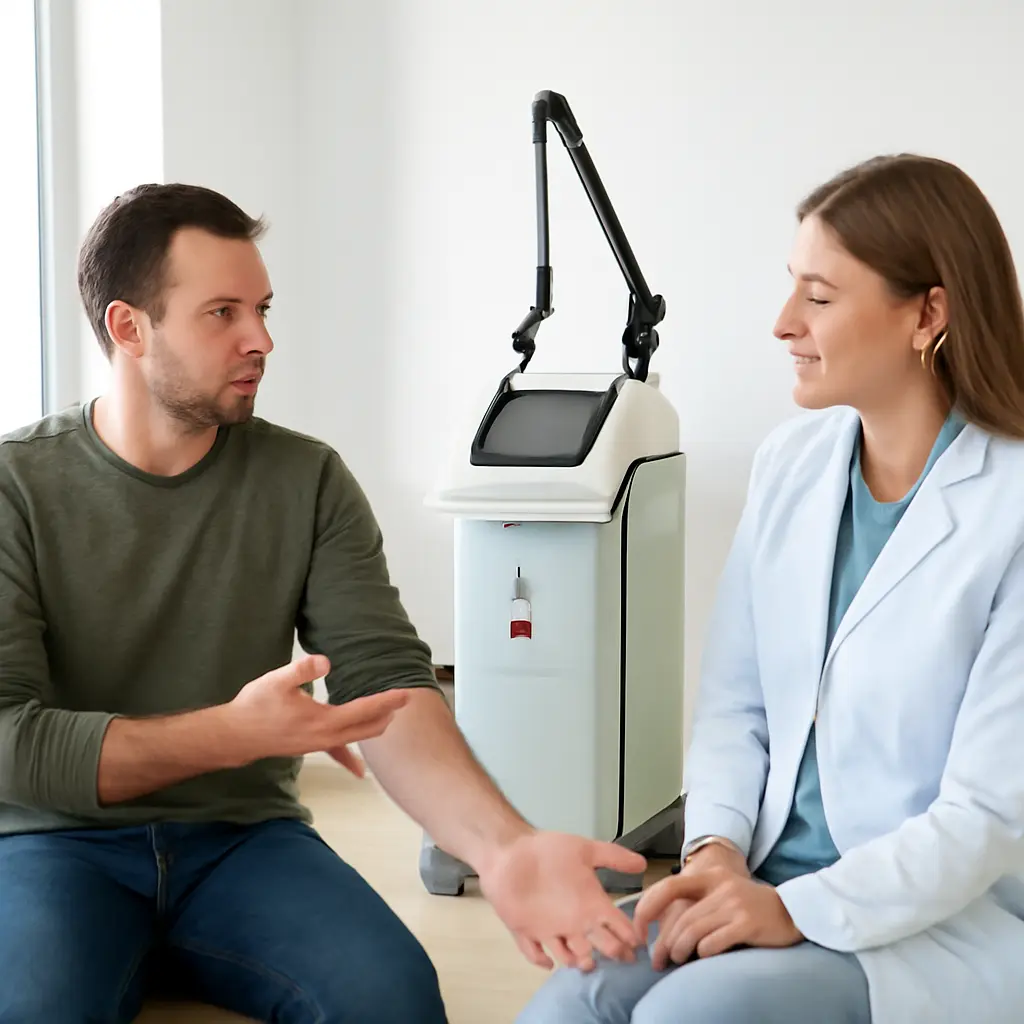
Laser tattoo removal is becoming more efficient for some clients, but “faster and less painful” depends on what is being measured: a shorter laser appointment does not necessarily mean fewer visits or an easier recovery. Modern Q-switched and picosecond lasers can deliver pulses in very short bursts, and cooling or topical anesthetics can help manage discomfort. Yet treatment still commonly takes multiple sessions, results vary with ink and skin characteristics, and the evidence does not establish that every newer device is less painful or reliably reduces the total treatment course. Understanding how laser technology works, what changes appointment time, and how pain and safety are managed can help prospective clients set realistic expectations.
Laser tattoo removal technology improves pulse delivery, not every part of treatment
Laser tattoo removal uses selected wavelengths of light to target tattoo pigment. The U.S. Food and Drug Administration explains that the pigment absorbs the laser energy, which breaks it into smaller particles that the body gradually clears. “Faster” can refer to the duration of an individual laser pulse, the time spent in the clinic, or the number of sessions required; these are different measures, and improvements in one do not guarantee improvements in the others.
The American Academy of Dermatology (AAD) says tattoo removal usually requires a series of treatments, with the number depending on factors such as tattoo size, color, location, and the patient’s skin. Its patient guidance describes sessions commonly spaced about six to eight weeks apart, allowing time for the skin to heal and the body to remove fragmented ink. That interval means even a brief procedure can be part of a months-long process.
Q-switched lasers: established short-pulse treatment
Q-switched lasers deliver energy in extremely short pulses and have long been used to target tattoo pigment. Different wavelengths are chosen to treat different colors; no single wavelength works equally well on every pigment. The FDA notes that some colors can be more difficult to remove than others, and a clinician may need more than one type of laser for a multicolored tattoo.
Picosecond lasers: shorter pulses, but not a universal shortcut
Picosecond lasers deliver pulses measured in trillionths of a second, compared with nanosecond-scale pulses from traditional Q-switched systems. Researchers have studied whether these shorter pulses can break some pigments into smaller particles and improve clearance, particularly for certain resistant colors. A systematic review published in Lasers in Surgery and Medicine found promising results for picosecond devices, while also noting that outcomes depend on tattoo and treatment characteristics and that more comparative research is needed. A shorter pulse is a technical feature—not proof that every tattoo will clear in fewer visits or with less discomfort.
Tattoo characteristics determine how quickly removal progresses
The treatment plan is shaped by the pigment as well as the device. The Kirby–Desai scale, a clinical tool published in the journal Dermatologic Surgery, groups relevant considerations into six factors: skin type, tattoo location, color, amount of ink, scarring or tissue changes, and layering. It is not a guarantee of a particular result, but it illustrates why two tattoos treated with the same laser can require different courses.
Ink color, composition, and layering
Black and dark-blue pigments often respond more readily to commonly used wavelengths than some green, yellow, and light-blue pigments. Professional tattoos may contain dense or layered ink, while cosmetic pigments can include ingredients that react unpredictably to laser exposure. The FDA warns that some tattoo pigments may darken rather than lighten when treated, so clinicians should assess the ink and consider a test spot when appropriate.
Tattoo size, location, and skin response
A larger tattoo generally takes longer to treat during an appointment than a small one. Location can also matter: the Kirby–Desai model accounts for distance from the heart, reflecting differences in how efficiently the body may clear pigment from different areas. Skin tone and a history of scarring or color changes are important because the laser must be selected and calibrated to reduce unwanted effects while targeting ink.
Session spacing and the total calendar time
Laser treatment does not remove all pigment at the moment of exposure. The body continues clearing fragmented particles after each appointment, and the skin needs time to recover. The AAD’s guidance of roughly six to eight weeks between sessions is a useful planning reference, not a promise that every person should follow an identical schedule. Rushing treatments can increase risk without ensuring faster clearance; the treating clinician should determine timing based on healing and response.
Pain can be managed, but removal is not painless
People commonly describe laser tattoo removal as a sharp snapping or stinging sensation. Pain varies with treatment area, tattoo size, individual sensitivity, and the laser settings used. The AAD notes that discomfort is common and that a dermatologist may use measures such as local anesthetic injections or other pain-control approaches. Cooling devices and topical anesthetics are also used in practice, but their suitability and effectiveness depend on the patient and treatment.
Cooling and anesthetic options
Cooling the skin before or during treatment may reduce discomfort and help protect the surface. A clinician may recommend a topical numbing medicine or local anesthesia, particularly for larger or more sensitive areas. These options can make a session more tolerable, but they do not eliminate all sensation, and anesthetics should be used under professional guidance rather than applied in excessive amounts or over large areas without advice.
Why “less painful” claims need careful interpretation
A device manufacturer’s pulse specifications do not directly measure a client’s pain experience. Research comparing laser platforms often focuses on pigment clearance, adverse effects, or clinical ratings, and may not use consistent pain measures across studies. Clients should ask a qualified clinician what pain-control method is available, what sensation to expect, and whether a small test area is appropriate. Claims that a technology is painless or universally more comfortable should be treated cautiously.
Safety and provider skill remain essential as devices advance
Laser tattoo removal is a medical procedure with possible side effects. The FDA lists risks that can include infection, scarring, changes in skin color, incomplete removal, and allergic reactions to pigment or its breakdown products. Temporary redness, swelling, blistering, or crusting may occur as the skin heals. Appropriate eye protection, device selection, settings, hygiene, and aftercare are central to safe treatment.
Choose a qualified clinician and discuss the tattoo
The AAD advises consumers to seek treatment from a board-certified dermatologist or a clinician working under appropriate medical supervision. Before beginning, discuss the tattoo’s colors and age, prior removal attempts, skin history, medications, expected session range, costs, and risks. Ask who will operate the laser, what device and wavelength are planned, and how complications will be handled.
Follow aftercare and allow the skin to heal
Aftercare instructions may include keeping the area clean, protecting it from sun exposure, and avoiding picking or friction while it heals. Follow the treating clinician’s directions and seek medical advice for worsening pain, spreading redness, pus, fever, or other signs of infection. The FDA also cautions that home tattoo-removal products and do-it-yourself methods can cause skin injury; professional assessment is the safer route.
What the next wave of clients can realistically expect
For many clients, the clearest improvement is a more informed, tailored treatment plan—not a guaranteed dramatic reduction in total time or pain. Newer picosecond systems may offer advantages for selected pigments, while established Q-switched lasers remain useful. Better cooling, careful wavelength selection, and individualized treatment can improve the experience, but the number of sessions and recovery time still depend on the tattoo and the person.
A useful consultation should separate three questions: How long will each appointment take? How many sessions might this particular tattoo need? What pain-control and safety measures will be used? Prospective clients should request realistic estimates rather than a fixed promise, and should compare providers on qualifications, assessment quality, and aftercare—not device branding alone.
Conclusion
Laser tattoo removal is advancing through shorter-pulse technologies and more tailored treatment, but faster pulses do not automatically mean fewer visits or painless sessions. Ink color, tattoo size and location, skin characteristics, session spacing, and clinician expertise all influence the outcome. Cooling and anesthetic options can help manage discomfort, while careful screening and aftercare reduce avoidable risks. Before booking, consult a qualified medical professional, ask how the proposed approach fits your tattoo, and treat broad claims of rapid or painless removal with caution.
Sources: U.S. Food and Drug Administration, “Removing Tattoos,” https://www.fda.gov/consumers/consumer-updates/removing-tattoos; American Academy of Dermatology Association, “Tattoo removal: Lasers outshine other methods,” https://www.aad.org/public/cosmetic/safety/tattoo-removal-laser; American Academy of Dermatology Association, “Tattoo removal: Options and results,” https://www.aad.org/public/cosmetic/safety/tattoo-removal-options; Alster TS and Tanzi EL, “PicoWay picosecond laser treatment of tattoos: A review of clinical evidence,” Lasers in Surgery and Medicine, https://pubmed.ncbi.nlm.nih.gov/; Kirby W, Desai A, Desai T, Kartono F, and Geeta P, “The Kirby-Desai Scale: A proposed scale to assess tattoo-removal treatments,” Dermatologic Surgery, https://pubmed.ncbi.nlm.nih.gov/